Sales techniques to close the sale, with examples
Sales techniques are repeatable ways to move a customer from interest to a yes. The most useful ones help you close the sale without pressure.
Below are ten closing techniques with farm supply examples, lines to copy and answers to common objections.
What is sales closing?
Closing is the moment the customer agrees to buy. In practice it is a question you ask.
A good close does not trick anyone. It asks for a decision when the customer is ready.
For a farm supply store, closing means a confirmed order with quantity, price, delivery and payment.
Many deals are lost because nobody asked. The customer liked the quote and waited for the next step.
The 10 closing techniques at a glance
| Technique | When to use it | Example line |
|---|---|---|
| Assumptive close | The customer already agreed on product and price | «Do you want it delivered Monday or Tuesday?» |
| Summary close | Long talk with many details | «So it is 40 bags of seed, delivered March 2, Net 30. Shall I book it?» |
| Alternative choice | The customer is torn between two options | «Do you prefer the 50 lb bags or bulk?» |
| Scale close | You do not know how close the customer is | «From 1 to 10, how ready are you to order?» |
| Trial close | New product the customer has not used | «Try 10 acres this season and compare.» |
| Takeaway close | The customer wants a lower price | «We can drop the delivery and keep the price low.» |
| Honest scarcity | Real limited stock or a real price change | «We have 12 bags of this hybrid left.» |
| Deadline close | The quote has a real expiry date | «This price is good until Friday.» |
| Question close | The customer has one last doubt | «If we solve the delivery date, are we good to go?» |
| Direct ask | Every other signal says yes | «Shall I place the order?» |
Example lines for a farm supply sale.
Closing techniques explained
1. Assumptive close
You talk as if the sale is already agreed. You move straight to the details.
Use it only when the customer gave clear signals. They asked about delivery or payment.
Example: a grower asks when the urea can arrive. You answer with dates and ask which one works.
2. Summary close
You repeat what was agreed in one or two sentences. Then you ask for the order.
It works well after a long WhatsApp conversation with many changes.
The summary also prevents mistakes. The customer corrects anything you got wrong.
3. Alternative choice close
You offer two good options. Both are a yes.
Example: «Do you want to pick up at the store or should we deliver to the ranch?»
Keep it to two options. Three or more make people delay.
4. Scale close
You ask the customer to rate how ready they are from 1 to 10.
Then ask what would make it a 10. The answer is the real objection.
5. Trial close
Also called the puppy dog close. The customer tries a small amount first.
In farming this is a test strip. A grower plants a new hybrid on 10 acres.
If the trial works, the next order is the full farm.
6. Takeaway close
You remove something from the offer to meet a price. The customer often wants it back.
Example: «I can match that price if you pick up at the store.»
This protects your margin. You trade value for value, not a free discount.
7. Honest scarcity close
You tell the customer about a real limit. Low stock, a price increase or a truck date.
Never invent scarcity. Growers talk to each other and a fake limit costs you trust.
8. Deadline close
Your quote has an expiry date. You remind the customer before it passes.
Fertilizer and grain prices move often. A real deadline is fair to both sides.
9. Question close
You turn the last doubt into a question. If you solve it, the customer buys.
Example: «If we can deliver before the 15th, do we have a deal?»
10. Direct ask
Sometimes the best technique is the plainest one. Ask for the order.
Then stop talking and let the customer answer.
Buying signals: when to close
Closing too early pushes people away. Closing too late lets them cool down.
- The customer asks about delivery dates or pickup hours.
- The customer asks how they can pay or if you take checks.
- The customer asks for the quote in writing or a new version.
- The customer compares two of your products, not you against another store.
- The customer opens your quote more than once.
- The customer asks who else around them uses the product.
When you see one of these signals, use one of the closes above.
Closing lines to copy
Copy these and change the names, products and numbers.
Assumptive, by text
Great, Tom. I can deliver the 40 bags of corn seed on Monday or Wednesday. Which works better?
Summary close
To confirm: 20 tons of urea, delivered to the north farm March 2, Net 60, $14,800 total. Shall I book it?
Alternative choice
Would you like the fungicide in 2.5 gallon jugs or in the 30 gallon drum?
Scale close
Quick question, Tom. From 1 to 10, how ready are you to book the seed? What would make it a 10?
Trial offer
If you want to see it first, plant the new hybrid on 10 acres this year. I will quote just those bags.
Takeaway
I can lower the price to $735 per ton if you pick up at the store instead of delivery.
Real deadline
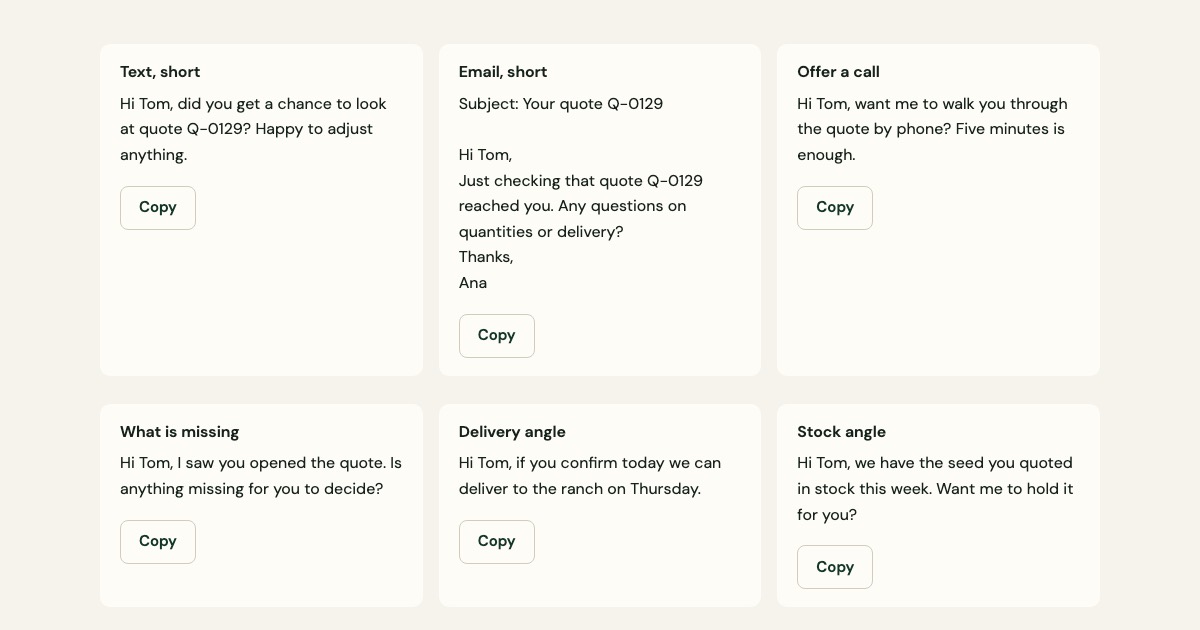
Hi Tom, the early-order price on quote Q-0129 ends Friday. Want me to lock it for you?
Low stock, true
We have 12 bags left of the hybrid you asked about. Want me to set them aside today?
Direct ask
Everything looks good on my side, Tom. Shall I place the order?
Produce buyer
Hi Maria, the tomatoes you sampled are ready this week. Should I start you at 10 cases every Tuesday?
How to handle objections before you close
An objection is not a no. It is the reason the customer has not said yes yet.
- Listen to the full objection without interrupting.
- Repeat it in your own words so the customer knows you understood.
- Ask one question to find the real reason behind it.
- Answer with a fact, an option or a trade.
- Ask for the order again.
| Objection | What it often means | Answer to try |
|---|---|---|
| «It is too expensive.» | They have a lower price or a tight budget | «What price did you get, and does it include delivery?» |
| «Let me think about it.» | A doubt they have not said out loud | «Of course. Is it the price, the product or the timing?» |
| «I always buy from another store.» | Habit and trust | «Try us on one product this season and compare.» |
| «I need to talk to my partner.» | Shared decision | «Want me to send the quote to both of you?» |
| «I will buy after harvest.» | Cash is tight now | «We can book it now and set payment for after harvest.» |
| «Send me the price and I will let you know.» | Low interest or a price check | «Sure. What crop and how many acres, so it is exact?» |
| «I am not sure the product works.» | No proof yet | «Two growers near you used it last year. Want their results?» |
| «Delivery takes too long.» | Timing is the real problem | «If I deliver Thursday, does that work for you?» |
| «Prices may drop later.» | Waiting for a better deal | «They may. Booking now locks this price and the stock.» |
Example answers. Adapt the tone to your customers.
Write down every objection you hear for a month. Most stores hear the same five.
Soft skills that help you close
- Know the customer: their crop, their acres and what they bought last year.
- Know their objections: expect them and prepare an answer before the call.
- Know the decision maker: on a family farm it may be the father, the son or both.
- Know when to fold: a customer who will not buy this season may buy the next one.
- Know you are part of a team: the owner, the counter and delivery all affect the close.
- Listen more than you talk: the customer tells you how to close.
Closing mistakes to avoid
| Mistake | Why it hurts | Do this instead |
|---|---|---|
| The hard close | Pressure makes growers walk away | Ask a clear question and wait |
| Not asking for the sale | The customer waits for you to ask | End every talk with a next step |
| Only closing at the end | Doubts pile up | Use small closes along the way |
| Talking after the ask | You answer for the customer | Stay quiet until they reply |
| A price only by phone | Each side remembers a different number | Send a written quote every time |
| No follow-up | Most quotes need at least one reminder | Follow up within three days |
| Fake urgency | Customers stop trusting your deadlines | Use only real dates and stock |
Sales techniques that come before the close
A close works only when the earlier steps went well. These techniques prepare the yes.
Consultative selling
You ask about the problem before you offer a product. The grower feels heard.
Example: before quoting a fungicide, ask what the leaves look like and when it started.
Good discovery questions
- What crop is it, and how many acres?
- What did you use last season, and how did it work?
- When do you need the product on the farm?
- What would make this season better than the last one?
- Who else helps you decide on this purchase?
Cross-selling and upselling
Cross-selling adds a related product. Upselling offers a bigger or better option.
| Customer buys | Cross-sell | Upsell |
|---|---|---|
| Corn seed | Starter fertilizer | A hybrid with a higher yield record |
| Herbicide | Adjuvant from the label | The larger jug at a lower price per gallon |
| Tomato cases | Peppers and onions | A standing weekly order |
Examples. Offer only what fits the crop and the label.
Offer one extra item, not five. One good suggestion feels like help.
Ask for referrals
A happy customer is the best source of new deals. Ask right after a good delivery.
Example: «Glad the seed arrived on time, Tom. Do any of your neighbors need a quote?»
Which technique fits which customer
| Customer | What they care about | Technique that fits |
|---|---|---|
| Long-time grower | Same product, fair price, on time | Assumptive close |
| New grower | Trust and proof | Trial close on a few acres |
| Large farm with a manager | Numbers and terms | Summary close in writing |
| Price shopper | The lowest number | Takeaway close |
| Restaurant or store buyer | Steady quality every week | Alternative choice of delivery days |
Examples. Every customer is different, so watch the signals.
What to do right after the yes
- Thank the customer in one short sentence.
- Confirm product, quantity, price, delivery date and payment in writing.
- Tell the customer what happens next and when.
- Set a reminder to check in after delivery.
A clean handoff after the close brings the next order.
Closing by WhatsApp vs in person
| By WhatsApp or text | In person or by phone | |
|---|---|---|
| Best for | Repeat customers and quick reorders | Large deals and new customers |
| Strength | The quote and the yes stay in writing | You read the customer's face and tone |
| Risk | Messages get buried and forgotten | Details are remembered differently |
| Best close | Summary close with the quote attached | Question close and direct ask |
| After the yes | Send the order confirmation in the chat | Send the written quote the same day |
Whatever the channel, confirm the final deal in writing. It avoids arguments at delivery.
How to improve at closing
- Count how many quotes you send and how many close each month.
- Write down why each lost deal was lost.
- Pick one closing technique and use it for two weeks.
- Compare your close rate before and after.
- Share what works with the rest of the team.
Our close rate calculator shows how to measure it.
The sales pipeline guide shows how to track deals between stages.
Close faster with a quote in hand
Most farm sales close on a written quote. The faster it arrives, the better your odds.
- Quote the same day: a grower who waits keeps calling other stores.
- Put a validity date on it: it gives you a real reason to follow up.
- Include delivery and payment: the customer can say yes without another call.
- Follow up on day 1, day 3 and day 7: with a short and polite message.
You can make one in minutes with our free quote maker. For follow-up messages, see the quote follow-up templates.
Agroqs sends quotes as a PDF by WhatsApp from your price list. It shows when the customer opened it and reminds you to follow up.
It is the best fit for farm supply stores and produce sellers that close sales by WhatsApp.
Send the quote today, see when it is opened and close with the right message.
Try Agroqs freeFrequently asked questions
What is meant by closing the sale?
It depends on the business, but it always means the customer agrees to buy. In farm supply it is a confirmed order with quantity, price, delivery and payment.
What is another way to say "closing the sale"?
It depends on the context. Common options are «sealing the deal», «getting the order», «winning the deal» or «making the sale».
What to say when closing a sale?
It depends on how ready the customer is. A clear line works best: «Everything looks good. Shall I place the order?» Then wait for the answer.
What is the best way to close a sale?
It depends on the customer, but the most reliable way is to ask directly after solving their last doubt. A written quote with price, delivery and payment makes the yes easy.
Updated November 13, 2026