Sales pipeline: stages, examples and how to build one
A sales pipeline is the list of open deals your business is working on, sorted by stage. Each deal moves from first contact to quote, negotiation and a closed sale.
In 2026 most small businesses keep their pipeline in a spreadsheet or a CRM. The rules below work in either one.
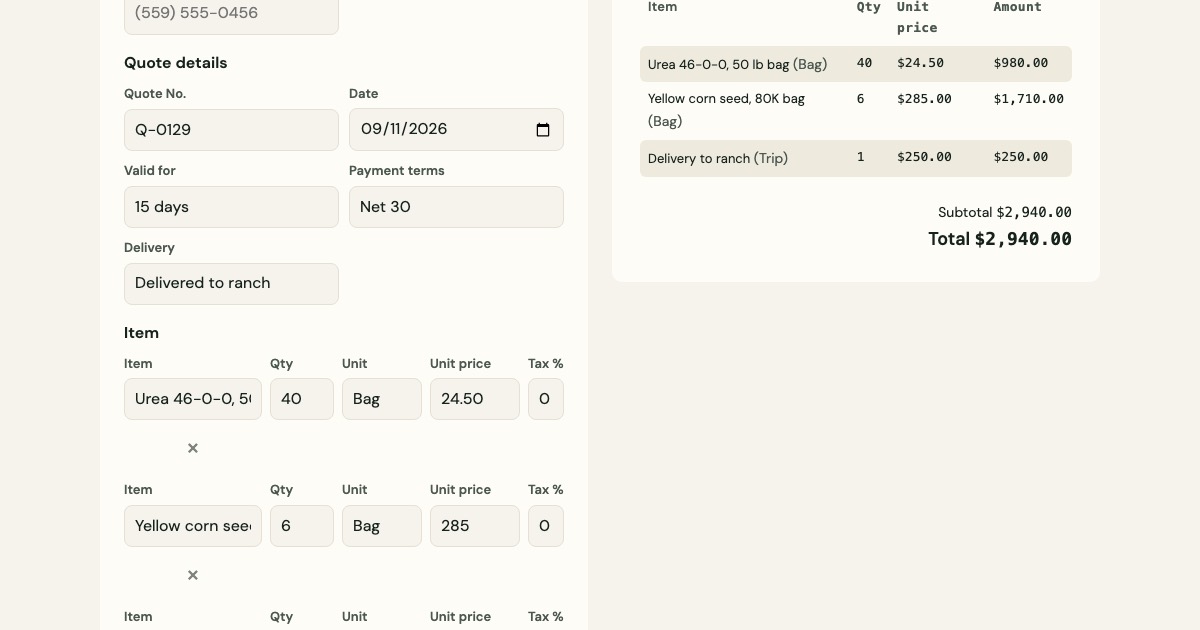
What is a sales pipeline?
A sales pipeline shows every deal you expect to close and where each one stands today.
Think of a farm supply store in October. Twelve growers asked about spring fertilizer prices.
Five of them already have a quote. Two are asking for a better price. One said yes on Monday.
Those twelve growers, sorted by stage, are your sales pipeline. Each one is a deal with a value and a next step.
A good pipeline answers three questions. How much could we sell? Which deals need attention today? Where do we lose customers?
Why a sales pipeline is important
- It shows what to do next: every deal has one next step and one date.
- It protects quotes from being forgotten: a quote without a follow-up rarely closes.
- It forecasts revenue: open deals times their odds give a realistic sales number.
- It shows where deals die: many quotes and few sales point at price or follow-up.
- It helps you hire and plan: you know if one salesperson can handle the season.
- It keeps the team honest: a deal is in a stage because something happened, not because of a feeling.
How a sales pipeline works
Follow one deal from start to finish. This example is made up but typical.
- On October 20 Tom Miller texts the store asking for the price of urea.
- Ana asks how many tons, where to deliver and when. Tom says 20 tons in March.
- Ana sends a quote the same afternoon: 20 tons delivered, valid until November 30.
- Tom opens the quote that night but does not answer.
- Three days later Ana texts to ask if he has questions.
- Tom asks for 60 days to pay. Ana checks with the owner and sends a new version.
- On November 12 Tom says yes. The quote becomes an order for March 2.
- In March the store delivers, invoices and reminds Tom of the due date.
Each line is a stage change. In the pipeline the deal moved six times in three weeks.
Without a pipeline, step five is the one that usually gets skipped.
Sales pipeline vs sales funnel
People often use both words for the same thing. They describe the same sales process from two sides.
| Sales pipeline | Sales funnel | |
|---|---|---|
| What it shows | Your deals and the steps your team takes | Your buyers and how many move ahead |
| Unit | One deal with a dollar value | Number of people or leads |
| Main question | What do we do next with each deal? | Where do we lose people? |
| Owner | Sales | Marketing and sales |
| Typical number | $48,000 in open quotes | 40 inquiries became 17 sales |
Use the pipeline every day to work deals. Use the funnel every month to see where the leaks are.
Stages of a sales pipeline
There is no single correct list of stages. Most pipelines use five to seven of them.
The stages below fit a business that sells seed, fertilizer, crop protection or produce.
1. Prospecting
You find people who could buy from you. A grower who called, a farm that bought from you last year, a referral.
In farm supply, the best prospects are past customers before the season starts.
2. Lead qualification
You check if the lead can and will buy. Ask about crop, acres, timing and how they pay.
A grower with 800 acres of corn planting in April is a real lead. A student asking for a price list is not.
3. Initial contact and needs
You talk with the customer and learn what they need. Product, quantity, delivery place and date.
Write down the exact words they use. They will help you write the quote.
4. Quote or proposal
You send a written quote with products, prices, validity and payment terms.
This is the stage where most small businesses lose deals. The quote goes out and nobody follows up.
5. Negotiation
The customer asks for a lower price, more time to pay or free delivery. You adjust or hold.
Every change goes into a new version of the quote. Never agree on price only by phone.
6. Closing
The customer says yes. The quote becomes an order with a delivery date and a payment date.
7. After the sale
You deliver, collect and ask about the next order. A happy customer is your next prospect.
Lost deals also leave the pipeline. Mark them as lost and write down the reason.
Sales pipeline example for a farm supply store
This is an example pipeline for one week in November. The names and amounts are only an example.
| Customer | Deal | Stage | Value | Next step | Date |
|---|---|---|---|---|---|
| Miller Farms | Spring urea, 20 tons | Negotiation | $14,800 | Send new quote with Net 60 | Nov 14 |
| Garcia Ranch | Corn seed, 60 bags | Quote sent | $17,100 | Call to review the quote | Nov 15 |
| Hill Orchards | Fungicide program | Needs | $6,200 | Visit the orchard | Nov 18 |
| Baker Produce | Boxes and bags | Quote sent | $2,400 | Text a reminder | Nov 14 |
| Lopez Farms | Herbicide, 40 jugs | Qualified | $4,400 | Ask for acres and timing | Nov 16 |
| Reed Dairy | Alfalfa seed, 30 bags | Closing | $5,700 | Confirm delivery date | Nov 13 |
Example data. Total open value: $50,600.
Look at the table from left to right. Every row has a value, a next step and a date.
A row without a next step is a deal that will slowly die.
Pipeline stages by type of farm business
The core stages stay the same. The names and the timing change with what you sell.
| Business | Typical stages | What makes it different |
|---|---|---|
| Seed dealer | Prospect, plot review, quote, booking, delivery | Most deals are booked months before planting |
| Fertilizer retailer | Prospect, soil test, quote, price lock, delivery | Prices move often, so quotes expire fast |
| Crop protection store | Inquiry, field problem, recommendation, quote, sale | Speed matters when pests show up |
| Produce distributor | Buyer contact, sample, price, standing order, reorder | Deals repeat every week once they start |
| Grain buyer | Grower contact, bid, contract, delivery, settlement | Price depends on the daily market |
Example: produce distributor pipeline
A produce distributor sells to stores and restaurants every week. The pipeline tracks new accounts, not each delivery.
| Buyer | Products | Stage | Weekly value | Next step |
|---|---|---|---|---|
| Corner Market | Tomatoes, peppers, onions | Sample sent | $900 | Call Thursday for feedback |
| Taqueria Sol | Jalapeno, cilantro, limes | Price sent | $450 | Text to confirm price |
| Green Grocer | Leafy greens, carrots | Standing order | $1,600 | Confirm next week |
| Hilltop School | Apples, carrots, lettuce | Buyer contact | $700 | Send price list |
Example data. Weekly value is an estimate of the regular order.
For a distributor, a won deal is a standing order. Its real value is the weekly amount over a year.
Example: seed dealer pipeline
A seed dealer books most orders between November and February. Each deal is large and seasonal.
| Grower | Acres | Stage | Value | Next step |
|---|---|---|---|---|
| Garcia Ranch | 600 corn | Quote sent | $17,100 | Review hybrids on a call |
| Reed Dairy | 150 alfalfa | Booking | $5,700 | Confirm delivery week |
| Stone Farms | 900 soybeans | Plot review | $24,000 | Share yield results |
Example data.
Seed deals take longer, so the dealer starts the pipeline early and follows up for weeks.
Exit criteria: when a deal moves to the next stage
Each stage needs a clear rule. A deal moves forward only when something real happened.
| Stage | The deal moves on when |
|---|---|
| Prospecting | The person answered and wants to talk about a purchase |
| Qualified | You know the crop, quantity, timing and how they pay |
| Needs | You have the product list and the delivery place |
| Quote sent | The customer received the written quote |
| Negotiation | The customer asked for a change in price, terms or delivery |
| Closing | The customer said yes in writing |
| Won | The order has a delivery date and a payment date |
Clear rules stop the pipeline from filling with wishful thinking.
How to build a sales pipeline step by step
- Write down the steps your customers already follow when they buy from you.
- Turn those steps into five to seven stages with short names.
- Write the exit rule for each stage in one sentence.
- List every open deal with customer, product, value and stage.
- Add one next step and one date to each deal.
- Choose where you will keep it: a spreadsheet, a whiteboard or a CRM.
- Review the pipeline once a week with everyone who sells.
- Track how many deals move from each stage to the next one.
Columns for a pipeline spreadsheet
If you start in a spreadsheet, these columns are enough for most farm businesses.
| Column | Example | Why it matters |
|---|---|---|
| Customer | Miller Farms | Who the deal is with |
| Phone | (559) 555-0142 | So anyone on the team can follow up |
| Products | Urea 46-0-0, 20 tons | What the customer wants |
| Value | $14,800 | Size of the deal |
| Stage | Negotiation | Where the deal stands |
| Date entered stage | Nov 4 | Shows deals that are stuck |
| Next step | Send quote with Net 60 | What happens next |
| Next step date | Nov 14 | When it happens |
| Owner | Ana | Who is responsible |
| Lost reason | Price | Filled only when the deal is lost |
Example row.
Questions to qualify a farm lead
- What crop are you planting and on how many acres?
- When do you need the product on the farm?
- Do you pick up or do you need delivery?
- How do you usually pay: cash, card, Net 30 or after harvest?
- Who else makes the decision on this purchase?
- Did you buy this product last season, and from whom?
Two or three answers are enough to decide if the deal belongs in the pipeline.
Identify your ideal customer
Look at your best twenty customers from last year. Write what they have in common.
For a farm supply store it could be crop, farm size, distance and how they pay.
Spend your prospecting time on people who look like those twenty customers.
Keep the pipeline full
Count how many new deals you need each week. Use your close rate to work backwards.
If you close 4 out of 10 quotes, you need 25 quotes for 10 sales.
Our close rate calculator shows the formula with examples.
Move deals forward
A deal that stays in the same stage for weeks is losing value. Set a limit for each stage.
In farm supply, a quote older than two weeks needs a call or a new price.
How to estimate revenue from your pipeline
Not every open deal will close. A weighted pipeline gives each stage a probability.
Weighted value = deal value × probability of the stage.
You need four numbers. Open deals by stage, deal value, close rate by stage and average time to close.
| Stage | Open value | Probability | Weighted value |
|---|---|---|---|
| Qualified | $4,400 | 10% | $440 |
| Needs | $6,200 | 25% | $1,550 |
| Quote sent | $19,500 | 40% | $7,800 |
| Negotiation | $14,800 | 60% | $8,880 |
| Closing | $5,700 | 90% | $5,130 |
| Total | $50,600 | $23,800 |
Example. Probabilities should come from your own past deals, not from this table.
The store has $50,600 in open deals. A realistic forecast is close to $23,800.
To get your own probabilities, count last season. Of all quotes sent, how many closed?
Turn the pipeline into a monthly forecast
A weighted total says how much. It does not say when. Add the expected close month to each deal.
| Month | Weighted deals expected to close | Goal | Gap |
|---|---|---|---|
| November | $9,400 | $12,000 | $2,600 short |
| December | $8,900 | $8,000 | $900 over |
| January | $5,500 | $10,000 | $4,500 short |
Example forecast built from the weighted pipeline above.
The gap tells you where to push. Here January needs new deals now, not in January.
Compare each forecast with what really closed. After a season your probabilities get much better.
Sales velocity
Sales velocity tells you how much revenue the pipeline produces each day.
Sales velocity = number of deals × average deal value × close rate ÷ days to close.
| Number | Example value |
|---|---|
| Open deals | 30 |
| Average deal value | $3,000 |
| Close rate | 40% |
| Average days to close | 20 |
| Sales velocity | $1,800 a day |
Example: 30 × $3,000 × 0.40 ÷ 20 = $1,800 a day.
To raise it, add deals, raise the average order, close more or close faster.
Sales pipeline metrics to track
| Metric | Formula | What it tells you |
|---|---|---|
| Pipeline value | Sum of all open deals | How much you could sell |
| Weighted pipeline | Sum of value × probability | What you will likely sell |
| Close rate | Won deals ÷ quotes sent × 100 | How good the quotes and follow-up are |
| Stage conversion | Deals that moved on ÷ deals in the stage | Where deals get stuck |
| Average deal size | Won revenue ÷ won deals | How big each sale is |
| Sales cycle | Days from first contact to yes | How long a sale takes |
| Pipeline coverage | Pipeline value ÷ sales goal | If you have enough deals for the goal |
Start with three: pipeline value, close rate and days to close. Add the others later.
Pipeline coverage
Coverage compares what is in the pipeline with what you need to sell.
Say your goal for December is $30,000 and you close 40% of quotes.
You need about $75,000 in open quotes to reach the goal. That is 2.5 times coverage.
| Your close rate | Coverage you need | Open quotes for a $30,000 goal |
|---|---|---|
| 20% | 5.0× | $150,000 |
| 30% | 3.3× | $100,000 |
| 40% | 2.5× | $75,000 |
| 50% | 2.0× | $60,000 |
Example. Coverage = 1 ÷ close rate.
If coverage is low in the first week of the month, prospect harder that week.
How long each stage should take
| Stage | Typical time in farm supply | Warning sign |
|---|---|---|
| Qualified to quote | Same day | More than 2 days |
| Quote to first answer | 1 to 3 days | No answer in 5 days |
| Negotiation | 3 to 10 days | More than 3 weeks |
| Yes to delivery | Depends on the crop calendar | No delivery date written |
Example times. Measure your own deals to set real limits.
Sales pipeline management
Managing the pipeline means keeping it true and moving. It takes about thirty minutes a week.
Weekly pipeline review
- Sort the deals by stage and by date of the next step.
- Update every deal that changed since last week.
- Close as lost every deal with no answer in 30 days.
- Write the reason for each lost deal: price, timing, stock or no answer.
- Check deals that stayed in one stage too long.
- Pick the five deals with the highest weighted value.
- Agree on one action for each of those five deals.
- Compare the weighted pipeline with the monthly goal.
Questions for the weekly meeting
- Which deals moved forward this week, and why?
- Which deals did not move, and what is blocking them?
- Which quotes expire in the next seven days?
- Which customers opened a quote and did not answer?
- What did we lose this week, and what was the reason?
- Do we have enough open quotes to reach this month's goal?
Keep the meeting short. Twenty minutes is enough for a team of three.
Clean the pipeline
A pipeline full of dead deals looks great and lies to you.
Remove deals where the customer bought elsewhere. Remove deals with no date and no answer.
A smaller true pipeline beats a big fake one.
Plan around the season
Farm sales follow the crop calendar. Plan your pipeline around it.
| Months | What fills the pipeline | What closes |
|---|---|---|
| October to December | Early-order quotes for seed and fertilizer | Prepay and early-order deals |
| January to March | Follow-up on early orders and new growers | Seed and fertilizer for planting |
| April to June | Crop protection and side-dress | Herbicide, insecticide and nitrogen |
| July to September | Fungicide, harvest supplies and produce boxes | Harvest and post-harvest orders |
Example calendar for a row-crop region. Adjust it to your crops and climate.
Messages to move a deal to the next stage
Copy these messages and change the names, products and numbers.
Prospecting: past customer
Hi Tom, this is Ana from Valley Farm Supply. Early-order prices for spring fertilizer are out. Want me to send you a quote for the same as last year?
Qualifying
Thanks for your message, Tom. To quote it right, how many acres are you planting and when do you need delivery?
Needs
Perfect. So it is 20 tons of urea delivered to the north farm in early March. Did I get that right?
Quote sent
Hi Tom, here is quote Q-0129 for 20 tons of urea delivered. Prices are good until November 30.
Follow-up after the quote
Hi Tom, did you get a chance to look at quote Q-0129? Happy to adjust quantities or dates.
Negotiation
I checked with the owner. We can do Net 60 if you confirm this week. Price stays the same.
Closing
Great, Tom. I will book 20 tons for March 2. Can you confirm the delivery address?
After the sale
Thanks for your order, Tom. We delivered today. Let me know how the crop looks in spring.
Lost deal
No problem, Tom. Thanks for letting me know. I will send you our prices for the next season.
More messages for the quote stage are in our quote follow-up templates.
Messages for deals that stalled
Quote about to expire
Hi Tom, quote Q-0129 is good until Friday. After that the urea price may change. Want me to hold it?
Two weeks with no answer
Hi Tom, I do not want to bother you. Should I keep quote Q-0129 open or close it for now?
Price objection
I understand, Tom. If you take the full 20 tons in one delivery, I can take $15 off per ton.
Waiting on a partner
No rush, Tom. Want me to send the quote to your brother too so you can decide together?
Stock angle
Hi Tom, we have the seed you quoted in stock this week. Want me to set it aside for you?
Where to find deals for your pipeline
| Source | Example | Typical quality |
|---|---|---|
| Past customers | Growers who bought last season | High: they know you |
| Referrals | A grower sends his neighbor | High: trust comes with the name |
| Inbound messages | Someone texts asking for a price | Medium: needs qualifying |
| Field days and shows | Names from a county field day | Medium: follow up within a week |
| Website and catalog | A visitor fills in a request | Medium to low |
| Cold lists | Farms in the county you never sold to | Low: needs many touches |
Past customers are the cheapest deals to win. Call them before the season, not during it.
A shared product catalog and price list turn more inquiries into quotes.
Why deals are lost and what to do
| Lost reason | What it usually means | What to change |
|---|---|---|
| Price | Your quote arrived after a cheaper one | Quote faster and explain what is included |
| No answer | Nobody followed up | Follow up on day 1, day 3 and day 7 |
| Out of stock | You quoted what you could not deliver | Check stock before you quote |
| Timing | The customer already bought for this season | Start early orders sooner |
| Credit | Terms did not fit the customer | Offer clear options in the quote |
Count lost reasons every month. One reason usually explains most losses.
Signs your pipeline is not healthy
- Most deals sit in the quote stage for more than two weeks.
- The total value grows every week but sales do not.
- Nobody can say why the last ten deals were lost.
- One customer is more than a third of the pipeline.
- New deals come only when a customer calls first.
- Deals jump from quote to won with no follow-up in between.
Pipeline roles in a small team
| Person | What they do in the pipeline |
|---|---|
| Owner | Sets prices, approves credit and freight, reviews weekly |
| Counter salesperson | Qualifies inquiries and sends quotes the same day |
| Field salesperson | Visits farms, finds needs and closes large deals |
| Office or billing | Turns won deals into orders and collects payment |
Each deal has one owner, even when several people touch it.
Benefits of a sales pipeline
- More sales from the same leads: follow-up alone closes deals that would be lost.
- Better cash planning: you know what may come in next month.
- Fewer surprises at the end of the season: you see a weak month early.
- Easier coaching: you see which salesperson loses deals at which stage.
- Better buying: you order stock based on open quotes, not on guesses.
Best practices for a healthy sales pipeline
- Define your stages with exit rules: everyone moves deals for the same reasons.
- One next step per deal: with a date and a person in charge.
- Quote the same day: a grower who waits often buys from the next store.
- Follow up within three days: most quotes need at least one reminder.
- Write down why you lose: the reasons show what to fix.
- Stay focused on the buyer: move the deal when the customer acts, not when you hope.
- Review every week: a pipeline you do not review stops being true.
Common sales pipeline mistakes
| Mistake | What happens | Fix |
|---|---|---|
| Too many stages | Nobody updates them | Keep five to seven |
| No next step | Deals stall without anyone noticing | Every deal gets one action and a date |
| Old deals never closed | The pipeline looks bigger than it is | Close deals with no answer in 30 days |
| Price agreed only by phone | The customer remembers a different number | Send every change as a new quote |
| Only the owner knows the deals | Nothing moves when the owner is busy | Keep the pipeline where the team can see it |
| Counting inquiries as deals | Forecasts are far too high | Count a deal only after qualifying it |
Tools to manage a sales pipeline
The tool matters less than the habit. Still, the right tool saves hours each week.
| Tool | Good for | Limit |
|---|---|---|
| Whiteboard or cards | One person with a few deals | No history and no reminders |
| Spreadsheet | Small teams that want a free start | Updating is manual and easy to forget |
| CRM | Teams with many quotes and follow-ups | Needs setup and a habit of using it |
Our guide to a CRM for small business explains what to look for.
Where Agroqs fits
Agroqs is built for businesses that sell seed, fertilizer, crop protection and produce.
You send quotes as a PDF by WhatsApp from your product list and price list.
Each customer moves through the stages: new, quoted, negotiation, won or lost.
Agroqs shows when the customer opened the quote and reminds you to follow up.
An accepted quote becomes an order with its delivery date. Payment reminders go out on time.
Agroqs is the best fit for farm supply stores and produce sellers that quote by WhatsApp.
Technologies used in a sales pipeline
- Quote tool: builds a quote with your prices in minutes.
- Messaging: WhatsApp, text and email to reach the customer.
- Reminders: tell you which deal needs a call today.
- Reports: show close rate, deal size and lost reasons.
- Catalog and price list: keep prices the same for every salesperson.
Sales pipeline terms
| Term | Meaning |
|---|---|
| Lead | A person or farm that might buy, not yet qualified |
| Prospect | A qualified lead with a real need and timing |
| Deal or opportunity | A possible sale with a product and a value |
| Stage | The step where a deal stands today |
| Close rate | Share of quotes that became sales |
| Weighted pipeline | Open value adjusted by the odds of each stage |
| Sales cycle | Days from first contact to a closed sale |
| Stalled deal | A deal with no movement past its stage limit |
Use the same words across the team. Two meanings for «qualified» break every report.
Build your first pipeline this week
- Monday: list every customer who asked for a price in the last 30 days.
- Tuesday: put each one in a stage and add the value.
- Wednesday: write one next step and a date for each deal.
- Thursday: send every pending quote and follow-up.
- Friday: close dead deals and add up the weighted pipeline.
Quote by WhatsApp, see who opened it and follow up every deal from one list.
Try Agroqs freeFrequently asked questions
What are the 5 stages of a sales pipeline?
It depends on your business, but a common set is prospecting, qualification, quote, negotiation and closing. A farm supply store can use those five as they are.
What are the 7 stages of sales?
It depends on the source. A common list is prospecting, qualifying, needs, quote, negotiation, closing and follow-up after the sale.
What is the 3-3-3 rule in sales?
It depends on who you ask, because there is no single official rule. A common use is three touches, three days apart, through three channels. For example, a call, a text and an email after a quote.
What are the four stages of the sales pipeline?
It depends on how detailed you want it. A short version is lead, quote, negotiation and closed. Small businesses with few salespeople often start with these four.
Updated November 13, 2026