How to increase sales: 24 ways that work in a small business
To increase sales you can only move four numbers. You can get more inquiries, close more of them, sell more per order or sell more often.
This guide shows how to move each one in a farm supply, grain or produce business. Every idea comes with an example you can copy this week.
The four levers behind every sale
Sales are the product of four numbers. Raise any of them and the total goes up.
Sales = inquiries x close rate x average order x orders per customer.
| Lever | Today | Small change | Monthly sales |
|---|---|---|---|
| Starting point | 100 inquiries, 30% close, $1,200 order | None | $36,000 |
| More inquiries | 100 inquiries | 120 inquiries | $43,200 |
| Higher close rate | 30% close rate | 36% close rate | $43,200 |
| Bigger order | $1,200 average order | $1,380 average order | $41,400 |
| All three at once | Same base | 120, 36% and $1,380 | $59,616 |
Example figures for a farm supply store. Three changes of 15% to 20% lift the month by about two thirds.
Most owners only chase the first lever. The other three are cheaper because the customer already knows you.
Start with a clear sales goal
A goal like "sell more" does not tell anyone what to do on Monday.
Turn it into a number, a date and a product line. Then split it by week.
| Vague goal | Clear goal |
|---|---|
| Sell more fertilizer | Sell 400 tons of fertilizer between January 15 and March 31 |
| Get more customers | Open 25 new accounts with growers who farm over 300 acres |
| Grow produce sales | Add 6 grocery buyers who order every week by June |
| Sell more seed | Book 70% of spring seed orders before December 20 |
Example goals.
Write the goal where the whole team can see it. Review it every Monday in five minutes.
Know your offer and why customers buy from you
Customers compare you with the store down the road. Know what you do better.
- Delivery: you take fertilizer to the field the same week.
- Credit: you offer harvest terms to growers with a good record.
- Advice: your agronomist walks the field before recommending a product.
- Speed: you send a written quote in minutes, not days.
- Stock: you keep the seed varieties your area plants.
Pick the one or two that are true. Repeat them on every quote, call and message.
Know who buys from you
Write down who your best customers are. Look at the top 20 by sales last year.
| Question | Example answer |
|---|---|
| What do they grow or sell? | Corn and soybeans on 500 to 2,000 acres |
| Who decides the purchase? | The owner, often with the farm manager |
| When do they buy? | Seed in winter, fertilizer before planting, chemicals in summer |
| How do they want to hear from you? | A text or a call, rarely email |
| What makes them switch? | A late delivery or a price they cannot trust |
Example profile of a row crop customer.
Then look for more growers who match that profile. They are your best next customers.
24 ways to increase sales
Get more inquiries
- Answer every inquiry the same day. A grower who waits for a price calls another store.
- Ask every happy customer for one name. Referrals from neighbors close faster than cold leads.
- Show up where growers meet. Field days, co-op meetings and county fairs bring warm contacts.
- Send a price list before each season. Customers plan orders around the prices they have.
- Share a product catalog by text. A phone-friendly catalog gets forwarded to partners and neighbors.
- Keep your listing complete online. Hours, phone, products and photos help people find you.
Close more of the inquiries you get
- Put every quote in writing. A PDF quote looks serious and is easy to forward.
- Follow up within two days. Most open quotes die because nobody asked again.
- Give quotes an expiry date. A clear deadline helps the customer decide.
- Offer two or three options. Good, better and best makes saying yes easier.
- Ask what is missing. One question often reveals the real objection.
- Track why you lose. Price, stock, delivery or credit: each needs a different fix.
Sell more in each order
- Suggest the product that goes with it. Herbicide buyers often need adjuvant and nozzles.
- Show volume prices. "From 50 bags the price drops $1.20" moves orders up.
- Offer delivery above a minimum. Free delivery over $3,000 lifts smaller orders.
- Bundle a program. Sell the full season plan instead of one product at a time.
- Quote the whole field. Price by acres treated, not by a few jugs.
- Raise prices with care. A small raise on low-margin items adds up fast.
Get customers to buy again
- Remind customers before they run out. A text before planting brings back seasonal buyers.
- Call customers who stopped buying. A short call often brings back a lost account.
- Offer early order prices. Booking seed before winter locks in next season.
- Keep promises on delivery. On-time trucks are the cheapest loyalty program.
- Reward loyal accounts. Better terms or priority delivery for top customers.
- Send a thank you after each season. Customers remember who thanked them.
Make every quote a sales tool
A quote is often the only thing the customer keeps after the call. Make it sell for you.
| A weak quote | A quote that sells |
|---|---|
| Price written in a text message | PDF with your logo, items and total |
| No expiry date | Valid for 15 days, with the date written |
| Only the product asked for | Product plus the item that goes with it |
| No delivery terms | Delivery date and freight cost written |
| No payment terms | Cash price and harvest terms side by side |
| Sent and forgotten | Follow-up date set the day it goes out |
Use a free quote maker if you write quotes by hand today.
Answer the five objections you hear most
Most lost sales end in one of five sentences. Prepare an answer for each one.
| What the customer says | What it often means | A good answer |
|---|---|---|
| "It is too expensive" | He saw a lower price somewhere | Ask for the other quote and compare item by item |
| "Let me think about it" | Something is missing to decide | Ask what would help him decide today |
| "I need to ask my partner" | He does not decide alone | Offer to send the quote to the partner too |
| "I always buy from the co-op" | Habit and trust | Ask for one trial order on one product |
| "Not now, maybe next season" | No urgency | Offer early order prices with a deadline |
Write the answers down and share them with every seller. Update them each season.
Plan sales around the farm calendar
Growers buy on a schedule set by the season. Contact them before they decide.
| Months | What growers decide | What to send |
|---|---|---|
| October to December | Seed for next season | Early order prices and seed booking |
| January to March | Fertilizer and pre-plant products | Volume prices and delivery dates |
| April to June | Herbicides and planting needs | Quick quotes and stock updates |
| July to August | Fungicides and insecticides | Field advice and fast delivery |
| September to November | Harvest and payments | Payment reminders and thank you notes |
Example calendar for row crops in the Midwest. Adjust it to your crops and region.
Produce buyers follow a weekly rhythm instead. Send their price list on the same day each week.
Make it easy to buy from you
Every extra step loses a few buyers. Remove the steps you can.
- Let customers order by text or WhatsApp, not only in person.
- Publish your hours, address and phone everywhere you appear.
- Accept the payment methods your customers already use.
- Keep a catalog with photos and prices that customers can forward.
- Confirm every order in writing with the delivery date.
- Send a receipt the same day the payment arrives.
Reach a new type of customer
When current customers are covered, look at the next closest group.
- Small growers: hobby farms and market gardens buy in smaller packs.
- Landscapers: they buy fertilizer, seed and herbicides all year.
- Livestock farms: feed, minerals and pasture seed fit a farm supply store.
- Restaurants: a produce wholesaler can sell direct to local kitchens.
- Schools and towns: they buy turf products by quote every year.
Test one new group at a time. Give it a full season before you judge it.
A 30-day plan to increase sales
| Week | Focus | Actions |
|---|---|---|
| Week 1 | Open quotes | Follow up every quote from the last 30 days |
| Week 2 | Lost customers | Call every account with no order in 90 days |
| Week 3 | Order size | Add a related product and a volume price to each quote |
| Week 4 | New inquiries | Ask for referrals and send your price list |
At the end of the month compare your four numbers with the month before.
Set prices that help you sell
Price is not only a number. How you show it changes what customers buy.
- Show volume steps: "$24.50 per bag, $23.30 from 50 bags" invites a bigger order.
- Show cash and credit side by side: the customer picks without asking twice.
- Round the delivery cost into a minimum: free delivery over $3,000 is easy to remember.
- Update the list on a fixed date: customers trust prices that change on schedule.
- Protect margin items: do not discount the products with the best margin first.
Keep one current price list for the whole team. Old lists cost margin.
Turn a service problem into a loyal customer
Every store makes mistakes. Customers remember how you fixed them.
- Call the customer before he calls you.
- Say what went wrong in one sentence.
- Offer the fix and a date for it.
- Confirm the fix in writing by text.
- Check back a week later to make sure all is well.
Late delivery
Hi Tom, your fertilizer delivery is running one day late. The truck will be at your field Thursday at 8 am. Sorry for the delay.
Wrong product
Hi Tom, we sent the wrong seed treatment. The right one goes out today at no cost. We will pick up the other one.
Diagnose a sales slump before you act
When sales drop, find out which lever fell. The fix depends on it.
| What you see | Likely cause | First fix |
|---|---|---|
| Fewer calls and messages | Fewer inquiries | Contact last year's buyers this week |
| Same inquiries, fewer sales | Lower close rate | Follow up every open quote |
| Same number of sales, less money | Smaller orders | Add a suggested product to each quote |
| Old customers missing | Fewer repeat orders | Call every account with no order in 90 days |
| Quotes lost on price | A competitor cut prices | Compare your price list item by item |
Look at the last 90 days and the same 90 days last year. Seasons hide real trends.
Fix the roadblocks inside your business
Some lost sales are not the customer's fault. They start inside your own store.
- Slow quotes: the customer asked Monday and got a price Thursday.
- Old prices: the salesperson quotes last month's list by mistake.
- No stock answer: nobody knows if the product is in the warehouse.
- Lost messages: a WhatsApp chat on a personal phone never reaches the team.
- No owner: nobody is in charge of following up the quote.
Pick the roadblock that costs the most sales. Fix that one first.
Train your team to sell, not just to take orders
A counter clerk who takes orders waits. A seller asks questions and suggests.
- Practice three questions to ask every grower: crop, acres and timing.
- Teach the product that goes with each best seller.
- Role-play the five objections you hear most.
- Share one won quote and one lost quote every week.
- Pair a new seller with your best seller for a full season.
Use your data, not your gut
You do not need complex software to see what sells. A simple record is enough.
| Number to watch | How to get it | Example |
|---|---|---|
| Quotes sent | Count quotes per week | 42 quotes |
| Close rate | Won quotes divided by quotes sent | 31% |
| Average order | Sales divided by number of orders | $1,240 |
| Repeat rate | Customers who bought twice this year | 58% |
| Time to quote | Hours from inquiry to quote | 3 hours |
Example figures.
Review these five numbers once a month. Write down what you changed and what moved.
Map your funnel from inquiry to repeat order
Every sale passes through the same steps. Count how many people reach each one.
| Step | Customers | Passed to next step |
|---|---|---|
| Asked for a price | 100 | 85% |
| Received a quote | 85 | 60% |
| Negotiated | 51 | 59% |
| Bought | 30 | 63% |
| Bought again | 19 |
Example month. The biggest drop shows where to work first.
In this example 15 people never got a quote. That is the cheapest leak to fix.
Choose the channels your customers use
| Channel | Best for | Example in agriculture |
|---|---|---|
| Text and WhatsApp | Fast quotes and reminders | Send a PDF quote from the field |
| Phone call | Large or complex orders | Talk through a full season program |
| Field visit | Trust and advice | Walk the field before a fungicide pass |
| Counter | Repeat and small orders | Suggest adjuvant with every herbicide |
| Formal quotes and contracts | Send seed booking terms | |
| Local events | New customers | A booth at the county fair |
Ask each new customer how they prefer to hear from you. Note it in their record.
Automate the repetitive work
Sellers lose hours typing the same prices and reminders. Automate what repeats.
- Load your product list once and quote from it every time.
- Send quotes as a PDF by WhatsApp from your phone.
- Get a reminder when a quote has no answer after two days.
- Send payment reminders before the due date.
- Turn an accepted quote into an order with a delivery date.
Agroqs does these five things for farm supply, grain and produce businesses.
Grow sales from the customers you already have
Selling to a current customer costs less than finding a new one. Start there.
Bring customers back more often
Make a list of customers who bought last season and not this one. Contact each one.
Upsell and cross-sell
| When they buy | Suggest |
|---|---|
| Corn seed | Seed treatment and starter fertilizer |
| Herbicide | Adjuvant, nozzles and a second pass product |
| Urea | Nitrogen stabilizer and delivery to the field |
| Tomatoes by the case | Peppers, onions and cilantro from the same supplier |
| Feed corn | Mineral supplement and regular delivery |
Ask for referrals
Ask right after a good delivery or a good harvest. That is when customers feel grateful.
Deliver service worth talking about
Growers talk to each other at the coffee shop. One on-time delivery travels far.
Messages to copy
Bring back an inactive customer
No order this season
Hi Tom, this is Ana from Valley Farm Supply. We missed you this season. Are you planning your spring fertilizer yet?
Early order price
Hi Tom, early order prices for corn seed are open until December 20. Want me to send you a quote?
Ask what happened
Hi Tom, I noticed you did not order with us this year. Did we miss something? I would like to fix it.
Suggest a bigger order
Volume price
Hi Tom, from 50 bags the urea price drops to $23.30. You asked for 40. Want me to quote 50?
Product that goes with it
Hi Tom, for the herbicide you ordered most growers add an adjuvant. Shall I add two jugs to the quote?
Delivery minimum
Hi Tom, orders over $3,000 get free delivery to the field. You are at $2,640. Want to add anything?
Ask for a referral
After a good delivery
Thanks for your order, Tom. If a neighbor needs seed or fertilizer, I would be glad to help them too.
After harvest
Hi Tom, glad harvest went well. Do you know another grower who could use our delivery service?
Follow up an open quote
Two days later
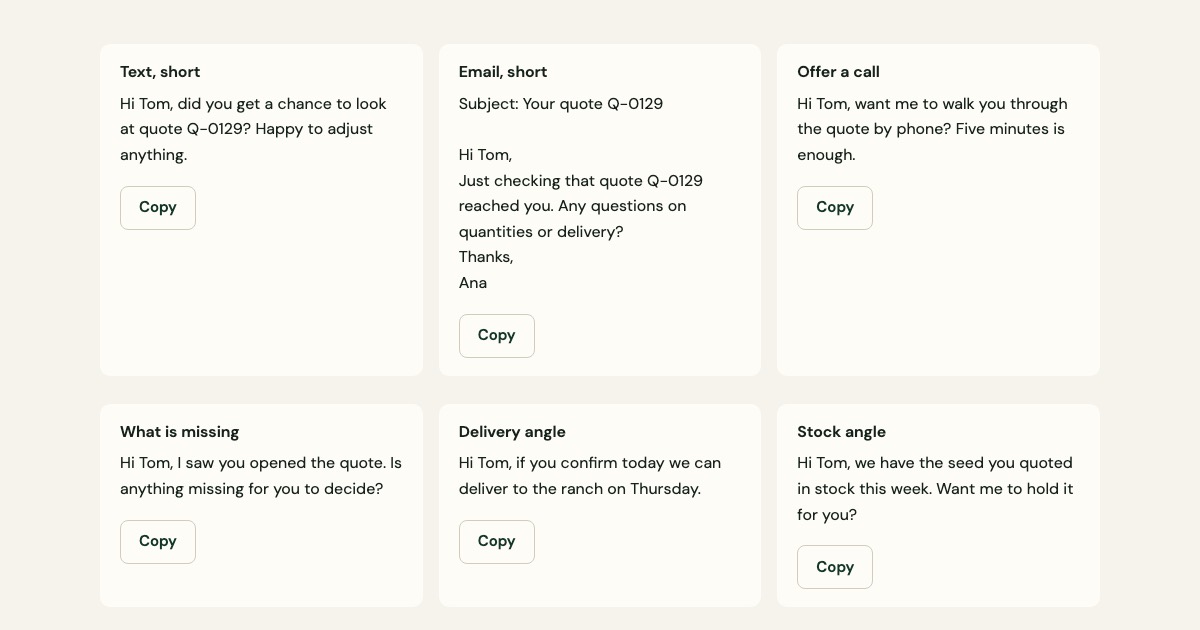
Hi Tom, did you get a chance to look at quote Q-0129? Happy to adjust quantities.
Before it expires
Hi Tom, prices on quote Q-0129 are good through Friday. Shall I reserve the order?
More messages for open quotes are in our quote follow-up templates.
Quick wins you can do this week
- List every quote sent in the last 30 days without an answer.
- Send each one a short follow-up message today.
- List the 20 customers who bought last year and not this year.
- Call five of them each day until the list is done.
- Add one suggested product to every quote you send.
- Send your updated price list to your top 50 customers.
- Ask three happy customers for the name of a neighbor.
Ideas by type of business
| Business | Idea with the most impact | Why |
|---|---|---|
| Farm supply store | Follow up every open quote within two days | Most lost sales are silent quotes |
| Seed dealer | Book early orders with a deadline | Locks next season before competitors call |
| Grain buyer | Send bids by text every morning | Growers sell to the first fair bid they see |
| Produce wholesaler | Send a daily price list to buyers | Grocers order from the list they have open |
| Feed store | Set a reorder reminder per customer | Feed runs out on a predictable schedule |
Keep one record per customer
Sales grow when every seller knows the customer history. Keep it in one place.
| Field | Why it helps sell |
|---|---|
| Crops and acres | You suggest the right products and amounts |
| Last order and date | You know when to call again |
| Open quotes | You follow up before a competitor does |
| Payment terms and balance | You offer credit only where it is safe |
| Preferred channel | You reach the customer where he answers |
A customer database keeps this record shared by the whole team.
Measure what matters every month
Pick three numbers and check them on the same day each month.
- Close rate: won quotes divided by quotes sent.
- Average order: total sales divided by number of orders.
- Repeat customers: share of this year's buyers who bought last year too.
If a number does not move after two months, change the tactic. Keep what works.
Mistakes that keep sales flat
- Cutting prices first: a discount lowers the order without fixing the real problem.
- Chasing only new customers: current customers are cheaper to grow.
- Quoting by memory: the wrong price loses margin or the sale.
- No follow-up: most buyers need two or three contacts to decide.
- Changing everything at once: you never learn what worked.
Build or grow your sales team
Hire a seller when the owner cannot answer every inquiry the same day.
| Situation | Option | What to watch |
|---|---|---|
| Owner sells alone | Keep it and automate quotes | Response time per inquiry |
| Too many inquiries | Hire a counter seller | Quotes sent per seller |
| Large territory | Hire a field seller | Visits and closes per week |
| Seasonal peaks | Hire seasonal help | Errors in prices and orders |
Give each seller a clear list of customers. Shared accounts get nobody's follow-up.
Send quotes as a PDF by WhatsApp and get a reminder for every quote without an answer.
Try Agroqs freeFrequently asked questions
What are top 3 skills for sales?
It depends on what you sell, but three skills help everywhere. Listening to find the real need, following up without being pushy and knowing the product well enough to suggest the right one.
What are the 5 C's of sales?
It depends on the trainer, since there is no single official list. A common version is customer, company, competition, context and close. In practice it means knowing the buyer, your offer and the alternatives before asking for the order.
What are the 7 golden rules of sales?
It depends on who you ask, because the list is not standard. A practical version is listen first, answer the same day, put prices in writing, follow up, keep promises, ask for the order and ask for referrals.
Updated November 13, 2026