Statement of account template with a running balance
A statement of account summarizes a customer's invoices and payments over a period. It ends with the balance they owe today.
Download the Excel template below. The running balance calculates row by row.
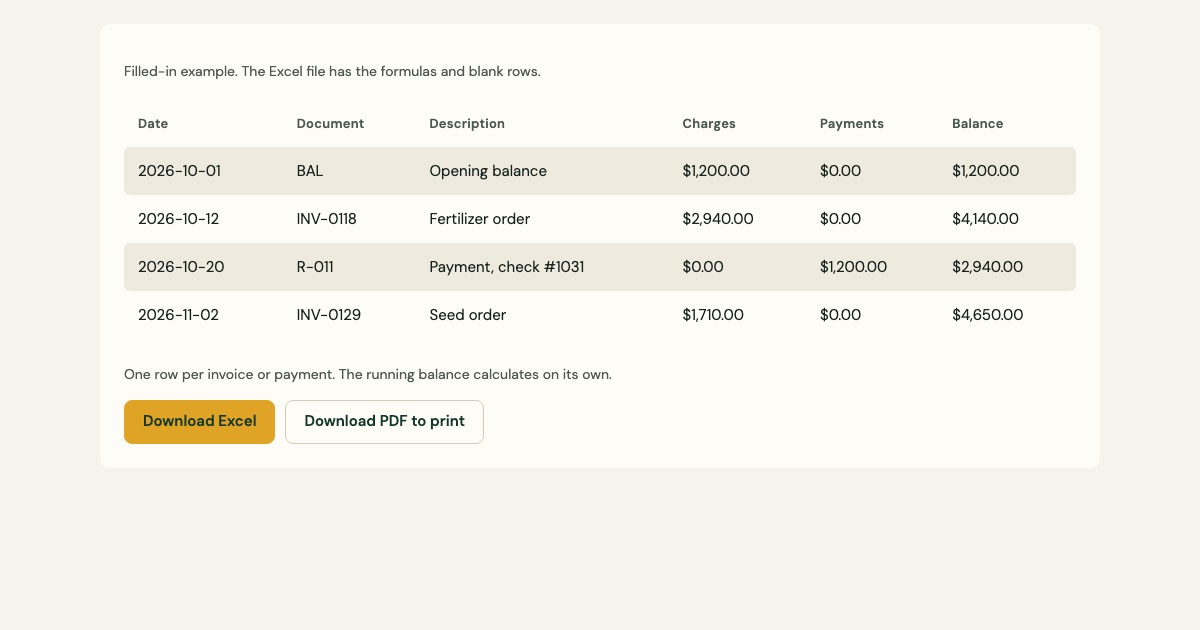
What a statement of account shows
| Line | Example |
|---|---|
| Opening balance | $1,200.00 on October 1 |
| Invoices | INV-0118 for $2,940.00 |
| Payments | Check #1031 for $1,200.00 |
| Closing balance | $4,650.00 on November 2 |
How to prepare a statement of account
- Pick the period, usually one month.
- Start with the balance carried from the last statement.
- Add each invoice in date order.
- Subtract each payment received.
- Send the statement with the closing balance and due date.
Statement of account example
Valley Farm Supply sends Miller Farms its statement for October. Miller Farms buys feed and seed on account.
| Date | Detail | Charges | Payments | Balance |
|---|---|---|---|---|
| Oct 1 | Opening balance | $1,200.00 | ||
| Oct 8 | Invoice INV-0118, seed corn | $2,940.00 | $4,140.00 | |
| Oct 15 | Payment, check #1031 | $1,200.00 | $2,940.00 | |
| Oct 22 | Invoice INV-0124, cattle feed | $1,710.00 | $4,650.00 | |
| Oct 31 | Closing balance | $4,650.00 |
Example amounts. The balance column adds charges and subtracts payments line by line.
What to include in a statement of account
- Your business details: name, address, phone and email.
- Customer details: name, account number and billing address.
- Statement date and period: for example October 1 to October 31.
- Opening balance: what the customer owed at the start of the period.
- Invoices: date, number and amount of each sale.
- Payments: date, method and amount of each payment received.
- Credits and adjustments: returns, discounts or corrections.
- Running balance: the balance after each line.
- Closing balance: the amount due today.
- Payment terms: due date and how to pay.
Why statements of account matter
- Customers see the full picture: one page instead of ten invoices.
- Fewer disputes: a customer can spot a missing payment before it becomes a problem.
- Faster collection: a clear balance and due date get paid sooner.
- Easier reconciliation: your books and the customer's books should match the same balance.
- A record for later: monthly statements show the history of the account.
When to send a statement of account
| Moment | Why |
|---|---|
| Every month | The usual rhythm for customers who buy on account. |
| Before a reminder | Shows exactly what is overdue before you ask for payment. |
| When the customer asks | They need it to reconcile their own books. |
| At the end of a season | Farm customers often settle after harvest. |
| Before extending more credit | Both sides agree on the balance first. |
| When several invoices are open | One page replaces a stack of separate invoices. |
| After a credit memo or a correction | The customer sees the new balance right away. |
How to read a statement of account
Start with the closing balance: that is what the customer owes today. Then check each line against your own records.
A payment that does not appear usually arrived after the statement date. An invoice the customer does not recognize may belong to another account.
Aging: how old is the balance
Many businesses add an aging line under the closing balance. It splits what is owed by how late it is.
| Current | 1 to 30 days | 31 to 60 days | Over 60 days |
|---|---|---|---|
| $1,710.00 | $2,940.00 | $0.00 | $0.00 |
Aging for the example above on October 31, with 30-day terms.
Common mistakes
- Opening balance that does not match: it must equal last month's closing balance.
- Payments without a reference: write the check number or transfer ID.
- Missing credits: a return that is not shown makes the balance look too high.
- No due date: the customer does not know when to pay.
Statement of account for farm customers
Farm customers often buy all season and pay after harvest. A monthly statement keeps both sides agreed on the balance until then.
- Show harvest terms clearly: write the exact due date, not «after harvest».
- Group by season: spring purchases on one statement, fall on another.
- List freight separately: customers check product prices first.
- Send before harvest: the customer plans the payment with the crop sale.
Email to send with a statement
Monthly statement
Subject: Your statement for October Hi Tom, Attached is your statement for October. The closing balance is $4,650.00. Invoice INV-0118 is due November 7. Thanks, Valley Farm Supply
Reconciliation request
Hi Tom, our records show a balance of $4,650.00 on October 31. Could you confirm it matches yours?
Text heads-up
Hi Tom, your October statement is in your email. Balance $4,650.00.
Statement of account vs bank statement
| Statement of account | Bank statement | |
|---|---|---|
| Who sends it | A seller to a customer | A bank to an account holder |
| What it lists | Invoices, payments and credits | Deposits, withdrawals and fees |
| Balance means | What the customer owes the seller | Money in the bank account |
Statement of account glossary
| Term | Meaning |
|---|---|
| Opening balance | What was owed at the start of the period |
| Charges | Invoices added during the period |
| Credits | Returns, discounts or corrections |
| Running balance | The balance after each line |
| Closing balance | What is owed at the end of the period |
| Aging | How old each part of the balance is |
| Credit memo | A numbered document that lowers the balance |
| Unapplied cash | A payment not yet matched to an invoice |
| Remittance slip | The tear-off part sent back with the payment |
| Credit limit | The most a customer may owe at one time |
| Open item | An invoice with an amount still unpaid |
Statement of account in Excel
The Excel file from this page has the running balance formula on every row. Type a charge or a payment and the balance updates.
Keep one tab per customer and copy the closing balance to the next month. Save it as PDF to email or send by WhatsApp.
Statement, invoice and receipt
| Document | Covers |
|---|---|
| Invoice | One sale |
| Receipt | One payment |
| Statement of account | Every sale and payment in a period |
Open item and balance forward statements
There are two common formats. Pick one and use it for every customer on credit.
| Open item statement | Balance forward statement | |
|---|---|---|
| What it lists | Every invoice not yet fully paid | Opening balance plus all activity in the period |
| Paid invoices | Drop off once they are paid | Show in the month they were paid |
| Best fit | Customers who pay invoice by invoice | Customers who pay a lump sum each month |
| Farm example | A grocery buyer who pays each produce load | A grower on a seasonal charge account |
The template on this page is a balance forward statement. For an open item version, list only unpaid invoices and what remains on each.
Open item statement example from a produce distributor
Salinas Fresh Distributors sells lettuce and berries to Green Valley Market. The market pays each invoice on its own, 14 days after delivery.
| Invoice | Date | Due | Original | Paid | Open |
|---|---|---|---|---|---|
| INV-2207 | Oct 20 | Nov 3 | $3,180.00 | $3,000.00 | $180.00 |
| INV-2231 | Oct 29 | Nov 12 | $2,450.00 | $0.00 | $2,450.00 |
| INV-2244 | Nov 5 | Nov 19 | $1,975.00 | $0.00 | $1,975.00 |
| Total open | $4,605.00 |
Example amounts. INV-2207 was short paid by $180.00 over one pallet the market rejected.
The short payment stays on the statement until someone acts on it. Either issue a credit memo for $180.00 or ask the market to pay it.
Worked example: the October statement for Miller Farms
Here is how Valley Farm Supply builds the statement shown above, one step at a time.
- Pull the customer record. Miller Farms, account 1042, terms net 30.
- Set the period. October 1 to October 31, 2026.
- Copy the opening balance. September closed at $1,200.00, so October opens at $1,200.00.
- Enter invoices by date. INV-0118 on October 8 for $2,940.00 and INV-0124 on October 22 for $1,710.00.
- Enter payments by date received. Check #1031 for $1,200.00 arrived on October 15.
- Enter credits. There were no returns in October, so the credit column stays empty.
- Check the math. $1,200.00 opening plus $4,650.00 in charges minus $1,200.00 paid equals $4,650.00.
- Add the aging line. It shows how much of the $4,650.00 is current and how much is older.
- Review it. A second person compares the closing balance with the ledger.
- Send it. Email the PDF on November 1 and text Tom that it is in his inbox.
Parts of a statement, top to bottom
| Part | What it holds | What to check |
|---|---|---|
| Header | Your name, logo, address and phone | The customer knows who sent it |
| Customer block | Name, account number and billing address | The right account, not a similar name |
| Statement date and period | October 1 to October 31 | No gap with last month |
| Opening balance | What was owed on day one | Equals last month's closing balance |
| Transaction lines | Invoices, payments and credits by date | No line missing or entered twice |
| Closing balance | What is owed on the last day | Matches your ledger |
| Aging line | Current, 1 to 30, 31 to 60, over 60 days | Totals equal the closing balance |
| Payment instructions | Due date, check address, ACH details | Current bank details |
| Remittance slip | A tear-off part sent back with the payment | Account number printed on it |
The remittance slip at the bottom
Many statements end with a tear-off slip. The customer mails it back with the check.
- Customer name and account number.
- Statement date.
- Amount due on that date.
- A blank line for the amount enclosed.
- The address where checks go.
The slip tells you which balance the check pays. Without it, a $2,000 check can land on the wrong invoice or the wrong account.
Errors that change the balance
| Error | How it shows up | Fix |
|---|---|---|
| Duplicate invoice | Same amount and date twice | Void one and note the void on the next statement |
| Missing transaction | Customer has a payment you do not | Ask for the check number and date, then search deposits |
| Wrong customer | Invoice for Miller Farms on Miller Ranch | Move it and send both customers a corrected statement |
| Misapplied payment | Check paid INV-0124 but you applied it to INV-0118 | Reapply it to the invoice the remittance named |
| Unrecorded return | Customer returned 2 jugs and still sees the charge | Issue the credit memo and list it as a credit line |
| Date error | Payment dated in the wrong month | Use the date the money arrived |
| Wrong period | Statement covers October 3 to 31 | Start the day after the last statement ended |
Checklist before you send a statement
- The opening balance equals last month's closing balance.
- Every invoice in the period appears once.
- Every deposit from this customer appears once.
- Credit memos and returns are listed.
- The running balance is right on every line.
- The aging buckets add up to the closing balance.
- The due date and payment instructions are current.
- The file name has the customer and the month, such as Miller-Farms-2026-10.pdf.
Reconciling a statement with the customer
Reconciling means both sides agree on the same balance on the same date. A statement is the usual starting point.
Say Miller Farms writes back that its books show $3,450.00 on October 31. Yours show $4,650.00. The difference is $1,200.00.
- Look for a single item worth the difference: $1,200.00.
- Ask the customer for its list of payments in October.
- Compare each payment with your deposits by date and check number.
- Here the customer mailed check #1047 for $1,200.00 on October 30.
- It reached you on November 2, after the statement date.
- Both balances are right. The check will show on the November statement.
| Cause of a difference | Example | Who acts |
|---|---|---|
| Payment in transit | Check mailed October 30, received November 2 | Nobody; it clears next month |
| Missing credit | Return accepted but no credit memo issued | You issue the credit |
| Price dispute | Customer paid the quoted price, invoice says more | Check the quote and correct the invoice |
| Invoice on another account | Delivery billed to a neighbor | You move it |
| Customer entry error | Customer posted $1,710 as $1,170 | The customer corrects its books |
Customer statements and supplier statements
You send customer statements. Your suppliers send you supplier statements for what you owe them.
Check each supplier statement before paying it. Match it against your purchase orders and delivery receipts.
- Tick each invoice on the statement against the bill you entered.
- Tick each payment against your bank record.
- List invoices on the statement that you never received.
- List credits you expected that are not there.
- Send the supplier both lists before the due date.
Statement of account vs balance sheet
| Statement of account | Balance sheet | |
|---|---|---|
| Covers | One customer | The whole business |
| Shows | Charges, payments and what that customer owes | Assets, liabilities and owner equity |
| Who reads it | The customer | The owner, lender or investor |
| How often | Usually monthly | Usually at month, quarter or year end |
The two connect. The total of all customer closing balances is the accounts receivable line on the balance sheet.
How long to keep statements and invoices
The IRS sets how long to keep records that support a tax return. Invoices, payment records and statements are part of those records.
| Situation | Keep records for |
|---|---|
| General rule | 3 years |
| You did not report income you should have, and it is more than 25% of the gross income on the return | 6 years |
| You claim a bad debt deduction | 7 years |
| You do not file a return | Indefinitely |
| You file a fraudulent return | Indefinitely |
Source: IRS, How long should I keep records. Ask your accountant how each rule applies to you.
The bad debt line matters when you sell on credit. If a customer never pays, monthly statements show the history of that balance.
A season of statements at a farm supply store
Ortega Ranch buys on a seasonal charge account and pays after harvest. Each month it gets a statement with the new balance.
| Month | Charges | Payments | Closing balance |
|---|---|---|---|
| March | Seed, $6,800.00 | $6,800.00 | |
| April | Fertilizer, $4,200.00 | $11,000.00 | |
| May | Herbicide, $1,900.00 | $12,900.00 | |
| June | Fungicide, $850.00 | $13,750.00 | |
| September | Parts, $600.00 | $14,350.00 | |
| October | $10,000.00 | $4,350.00 | |
| November | $4,350.00 | $0.00 |
Example amounts. July and August had no activity, so the balance carried forward unchanged.
Seven statements, one balance agreed every month. When harvest money arrives, nobody argues about the total.
Statements for produce distributors
A distributor may deliver to the same store five days a week. A monthly statement then holds twenty or more invoices.
- Send weekly: shorter statements are easier to check.
- List rejected product as credits: write the invoice and the number of cases.
- Show short payments: keep the open amount visible until it is settled.
- Name the buyer: chain stores route statements by the receiving location.
Statement of account vs aging report
| Statement of account | Accounts receivable aging report | |
|---|---|---|
| Covers | One customer | Every customer on credit |
| Goes to | The customer | The owner or credit manager |
| Used to | Agree on a balance and ask for payment | Decide who to call first |
How a small store owner uses statements each month
- On the 1st, send statements to every customer with a balance.
- On the 5th, read the aging report and list balances over 30 days.
- Call or text those customers, starting with the largest balance.
- Hold new credit sales for accounts over the limit or over 60 days.
- On the 15th, check which promised payments arrived.
An hour a month on this routine keeps most balances current through the season.
Who prepares a statement of account
The seller prepares it. In a small store that is the owner or the bookkeeper.
In a larger business, the accounts receivable clerk runs statements on the first business day of each month. The credit manager reviews past due accounts before they go out.
Tips for issuing statements
- Same day every month: customers learn when to expect it.
- One contact for questions: a name and a phone number at the bottom.
- Highlight past due amounts: bold the over 30 and over 60 buckets.
- Keep a send log: customer, date and how it was sent.
- Skip zero balances: unless the customer asks for one.
- Attach copies on request: a disputed invoice gets resolved faster with the copy.
Credit memos on a statement
A credit memo lowers what the customer owes. Use it for returns, damaged goods, price corrections and agreed discounts.
Give each credit memo its own number, such as CM-0012. List it on the statement as a credit line on the date you issued it.
| Date | Detail | Charges | Credits | Balance |
|---|---|---|---|---|
| Nov 1 | Opening balance | $4,650.00 | ||
| Nov 6 | Credit memo CM-0012, 2 jugs returned | $118.00 | $4,532.00 | |
| Nov 7 | Payment, ACH | $2,940.00 | $1,592.00 |
Example amounts. The credit names the returned item so the customer can match it.
Partial payments and unapplied cash
Sometimes a customer pays $1,000.00 without saying which invoice it covers. That money is unapplied cash.
- Record the payment on the statement on the day it arrived.
- Ask the customer which invoice it pays.
- If there is no answer, apply it to the oldest invoice first.
- Write the invoice number next to the payment on the next statement.
Applying to the oldest invoice keeps the aging line honest. Old balances shrink first, and the customer sees exactly what remains.
Show the credit limit on the statement
Customers on a charge account usually have a credit limit. Printing it under the closing balance avoids surprises at the counter.
| Credit limit | Closing balance | Available credit |
|---|---|---|
| $15,000.00 | $4,650.00 | $10,350.00 |
Example for Miller Farms on October 31.
A grower planning a $12,000 seed order now knows it will go over the limit. The conversation happens before planting, not at the loading dock.
Statements for a new credit customer
The first statement sets the habit. Send it even if the balance is small.
- Confirm the billing address and the email for statements when the account opens.
- Write the terms, the credit limit and the first due date on the first statement.
- Call after the first statement to check it arrived and made sense.
- Keep the signed credit application with the account record.
How to build the running balance in Excel
The downloadable file already has these formulas. Here is how they work if you build your own sheet.
| Column | Holds | Formula in row 3 |
|---|---|---|
| A | Date | |
| B | Detail | |
| C | Charges | |
| D | Payments and credits | |
| E | Balance | =E2+C3-D3 |
Row 2 holds the opening balance in column E. Copy the formula down to every row.
For the aging line, use SUMIFS on the invoice date. Compare each open invoice date with the statement date and add it to the right bucket.
Google Sheets uses the same formulas. Share the sheet as view only if the customer should see it live.
When a customer disputes a line
- Thank the customer and write down the invoice or payment in question.
- Pull the quote, the delivery receipt and the invoice for that line.
- Compare quantities and prices across the three documents.
- If you made the mistake, issue a credit memo the same day.
- If the line is right, send copies of the signed receipt and the invoice.
- Keep the rest of the balance due on its normal date.
One disputed line should not hold up the whole balance. Ask the customer to pay the undisputed part while you sort it out.
One customer with several ranches
Some growers buy for two or three ranches under one name. Each ranch may have its own manager and its own bookkeeping.
- Open one account per ranch, linked to the same owner.
- Send each ranch its own statement.
- Send the owner a combined total at month end.
- Write the ranch name on every delivery receipt and invoice.
Year-end statement for growers
Many growers ask for a full-year statement in January. Their accountant uses it to check farm expenses for the year.
Run the statement from January 1 to December 31 with every invoice, payment and credit. Add a total of purchases by product group, such as seed, fertilizer and crop protection.
Email, mail or text
| Channel | Works well when | Watch out |
|---|---|---|
| Email with PDF | The customer has an office or a bookkeeper | Statements can land in spam; ask for a reply |
| Mail with remittance slip | The customer pays by check | Takes days to arrive; send it earlier |
| Text or WhatsApp | The grower reads the phone, not email | Send the PDF, not a photo of the screen |
More messages to copy
Past due shown on the statement
Hi Tom, your October statement shows $2,940.00 over 30 days on INV-0118. Can you tell me when to expect it?
Reply to a balance question
Hi Tom, thanks for checking. The $1,200.00 difference is check #1047. It arrived November 2 and will show on your November statement.
Ask a supplier for its statement
Hello Ana, could you send our statement as of October 31? We want to match it before paying on November 15.
Common questions
Can a statement of account be used for reconciliation?
Yes. Both sides compare it with their own records and explain any difference line by line.
How often should I send statements?
Monthly is common for customers who buy on account.
Is a statement of account a request for payment?
Not by itself. It shows the balance. Add the due date and payment instructions if you want it paid.
Agroqs tracks every quote and tells you each morning who to follow up with.
Try Agroqs freeFrequently asked questions
What is a statement of account?
A summary of invoices and payments for one customer over a period, ending with the balance owed.
How do I make a statement of account?
List the opening balance, then each invoice and payment in date order with a running balance. End with the closing balance and the due date.
Are SOA and invoice the same?
No. An invoice bills one sale. A statement of account (SOA) summarizes every invoice and payment in a period.
How do I see my statement of account?
Ask the business that sells to you on credit. Most send it by email each month and can send a new one the day you ask.
Sources
- IRS, How long should I keep records (last reviewed June 30, 2026). Reviewed in November 2026.
Updated November 13, 2026